
Empowering scientists to reach for the edge of the possible
Scroll to get to know ARIAARIA is a UK R&D funding agency built to unlock scientific and technological breakthroughs that benefit everyone.
Society’s most important advances have stemmed from those willing to think differently about what might be possible.
The Advanced Research + Invention Agency (ARIA) empowers scientists and engineers, from our Programme Directors to the teams we fund, with the resources and freedom to pursue breakthroughs at the edge of the possible.
Many will fail to meet their target, but their efforts will inspire the next generation. Those that do succeed will generate massive social and economic returns.
The latest from ARIA

Precision Mitochondria
Read the request for proposal and submit your application
Discover more
Universal Fabricators
Explore the Creators and projects we're funding in this programme
Discover more
Scaling Trust
Meet the Creators we're funding in the Scaling Trust programme
Discover more
Opportunity spaces
ARIA's opportunity spaces are the frontiers where we believe transformational breakthroughs are possible. They're our strategic visions of the future: areas of unmet opportunity where we believe new capabilities will most benefit humanity and where ambitious research could fundamentally change what becomes possible.
Each opportunity space is highly interdisciplinary – spanning multiple disciplines and potential applications in new ways. Together, they form our framework for discovering and exploring new ideas – from guiding the development of our programmes all the way through to funding researchers to unlock these visions and build the future.
Discover our opportunity spaces below:

Nature-Inspired Computation
Programme: Scaling Compute
Programme: Olfactory Perception
Unsustainable energy requirements and limited datasets demand alternative scaling pathways for AI. Novel computing, learning and perception paradigms inspired by nature will enable radically greater efficiency and adaptability.
Open calls
Programme Funding
Robot Dexterity: Benchmarks, Standards + Interoperability – Request for Proposal
Alongside its work on hardware components, the Robot Dexterity programme is backing efforts to turn those advances into complete, field-ready systems. Progress across the field will be easier if developers can combine technologies from different sources, assess what they can do, and build on one another’s work. We will be seeking proposals to develop benchmarks, standards, interfaces, or other shared capabilities that make it easier to develop and deploy dexterous robots. Standards for tactile sense data are a particular priority, alongside wider work on benchmarking, performance evaluation, hardware and software interoperability, and shared testing infrastructure. Outputs should be useful to the wider robotics community, with benefits extending well beyond the UK.
Opportunity space
Adaptive Machines
Programme Director
Jenny Read
Deadline
01 December 2026
Programme Funding
Precision Mitochondria: ST&R – Request For Proposal
The Precision Mitochondria programme aims to create a foundational toolkit for engineering the mitochondrial genome in vivo. Achieving this will require advances in delivery, expression, maintenance and transfer to work together – and for teams to be able to assess, reproduce and adapt one another’s methods. We will be seeking proposals from teams able to be the dedicated partner(s) to provide the shared scientific, technical and practical resource needed to turn promising individual advances into dependable capabilities that can be used across the programme. This includes, but is not limited to, supporting the transfer of methods and materials between laboratories, establishing shared benchmarks and reporting standards, and independently evaluating and reproducing results.
Opportunity Space
Programmable Physiology
Programme Director
Ryan Olf
Deadline
09 November 2026
Programme Funding
Safeguarded AI: Cybersecurity – Rolling applications
This £20m funding call seeks to test and accelerate the hypothesis that AI-enabled formal methods can make high-assurance cyber defence practical at scale. We're accepting proposals on a rolling basis, reviewed in quarterly batches, for Blue Teams (3–6 teams, approx. £2.5–3.5m each) to build production-grade, security-critical software components whose key security properties are backed by machine-checked proofs – validated through coordinated red-team exercises.
Opportunity space
Trust Everything, Everywhere
Programme Director
Nora Ammann
Deadline for current batch
31 October 2026
Programme Funding
Scaling Trust: Tracks 2+3 – Rolling applications
This £49.8m programme seeks to build tools for agents to securely interact with one another in untrusted environments while respecting the preferences of their users. We're accepting proposals on a rolling basis, reviewed in quarterly batches, across two tracks: Track 2 – Tooling (4–6 teams, £200k–£2m each) to build open-source agents and reusable components for secure requirement capture, negotiation, protocol generation, and verification; and Track 3 – Fundamental Research (three Research Centres plus 4–12 smaller teams, £100k–£3m each) to turn empirical security into provable guarantees and unlock new cyber-physical trust primitives for agents.
Opportunity space
Trust Everything, Everywhere
Programme Director
Alex Obadia
Deadline for current batch
31 October 2026
Featured insights
Building on what works and going further
We’re excited to introduce our five new Activation Partners
Read more
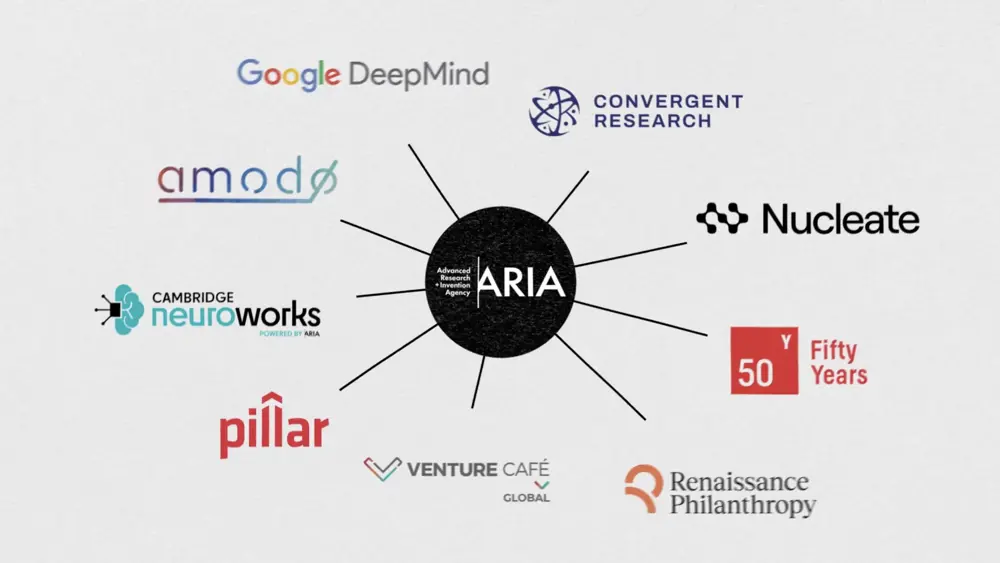
From hypothesis to headway
What our founding Activation Partners have made possible
Read more
From new chips to working systems
Suraj Bramhavar reflects on the journey of Scaling Compute
Read more