
Designing an Early Warning System (EWS) for North Atlantic tipping points should not take place in isolation, and should be informed by a range of actors at all stages of the value chain. Since the EWS can only be as useful as the response it enables, taking a broad view at this mid-point of the programme allows a checkpoint to engage stakeholders and take stock of information generated in the programme so far.
This white paper has been produced by a working group within the Forecasting Tipping Points programme as a way to lay out the building blocks that are required to design the system. It highlights present knowledge as well as areas where more research is required or where the programme would benefit from more external expertise or stakeholder engagement.
This paper hopes to continue to inform and shape discussion, without recommending an explicit EWS design.
Introduction
Passing potential tipping points in North Atlantic Ocean circulation could have major impacts on global and regional climate, emerging over decadal to centennial timescales and potentially irreversible for centuries. This brief provides a summary of the potential benefits and risks of producing an Early Warning System for these tipping points, the large remaining uncertainties, barriers and the design areas needing stakeholder engagement.
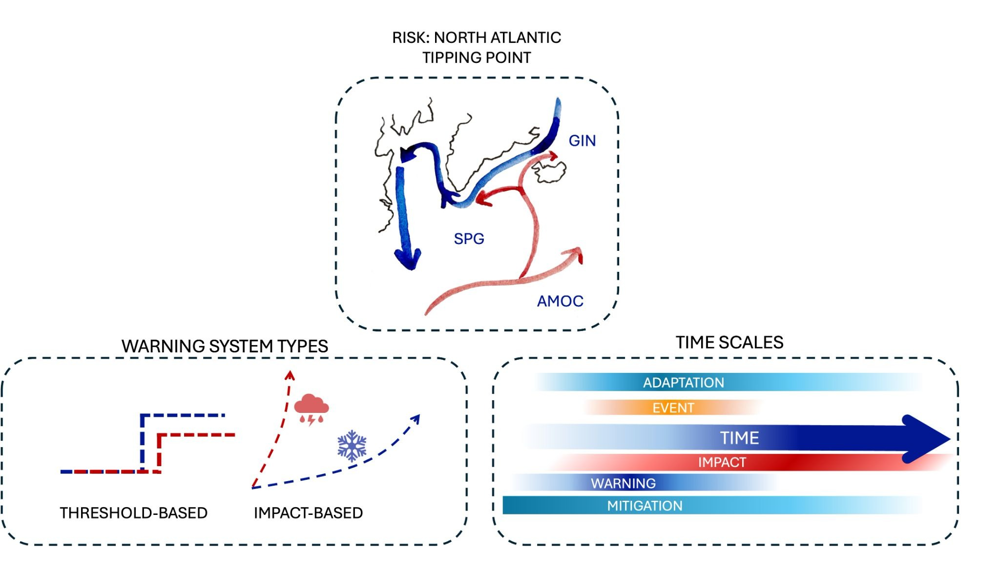
North Atlantic Tipping
We focus on potential tipping points in the North Atlantic ocean, here comprising collapse of deep convection in the Sub-Polar Gyre (SPG), the Greenland-Irminger-Nordic (GIN) seas and a resulting collapse of the Atlantic Meridional Overturning Circulation (AMOC). A collapse here means an abrupt and substantial weakening (>50% decline) of deep convection or overturning circulation, which is hard to reverse on human timescales. There is evidence from models and paleoclimate records that these systems can undergo tipping, and observations suggest they may have weakened in recent decades. The resulting transitions could occur within 10-20 years for convection collapse, and a longer timescale of 50-100 years for AMOC collapse. The impacts are uncertain, but convection collapse would likely lead to regional cooling across northwestern Europe and more severe winter storms. AMOC collapse would likely involve cooling of multiple degrees across Western Europe, especially in winter, alongside large shifts to precipitation patterns and monsoons globally.
Early Warning System Design
An Early Warning System (EWS) aims to provide information on the potential timescales and impacts of a hazard and to enable effective responses on decision-relevant timescales. Stakeholders and end-users are therefore critical to co-designing an EWS as their response actions are the fundamental output. Any design must take this into account to ensure an EWS is useful and usable. Its purpose is to provide advance warning of catastrophic impacts due to tipping, allowing time for mitigation and, more likely, adaptation responses. There are four established pillars to an effective EWS: 1. Risk Knowledge, 2. Monitoring and Warning, 3. Warning Communication and Dissemination, 4. Response capability.
Two, complementary EWS designs are being considered: (1) Impact-based system. This involves considering possible future trajectories, system states and their impacts and designing strategies that are robust and adaptive to the full range of potential outcomes, while recognising that worst-case scenarios are necessary for risk management. (2) Threshold-based-system. This involves the prediction of, and agreement on, a tipping threshold (from physical understanding, models, data, and stakeholder input) and observational monitoring (present day, and informed by the paleo-climate record) to aid early warning and detect the crossing of a threshold.
Critically, in both systems, response to the early warning should be governed by the impacts, whether an adaptation to those impacts or an effort to avoid them is appropriate. Warnings need to be combined with thorough uncertainty assessment to enable decision-makers to understand the range of possible outcomes and the confidence in any given warning. The design of an early warning system must also consider who would benefit from a warning, how they could/should respond to a warning, and how the warning can be communicated in a way that is credible, reliable, and useful.
Responses
An EWS for tipping is primarily intended to inform adaptation action. As the timescales between a warning and the potential tipping are likely to be short, mitigation to avoid tipping is less likely to be feasible, and geoengineering interventions remain highly uncertain in both their efficacy and their knock-on effects. The key benefits of an EWS would likely lie in reducing the societal impacts of tipping whether through reducing exposure, vulnerability or building resilience to these impacts. Stakeholder input is needed to unpack potential response options, for example improving robustness of infrastructure, or adjusting agricultural practices. Given deep uncertainty around both the impacts and their timescales, methods for decision making under deep uncertainty may be required to ensure robust policies are put in place that avoid maladaptation to the various possible scenarios.
EWS come with risks of overconfidence (the warning might say there is no risk yet and promote overly risky behaviour) or misuse (warnings of potential systems collapse with uncertain impact could be used to motivate extreme responses and securitisation or risks which may be inappropriate). Strong governance systems must be integrated with the EWS to ensure it is useful to warning recipients and beneficial to wider society.
Scientific challenges
The ARIA FTP programme is tackling several key research challenges towards an EWS:
Observational records need to be maintained, and where possible extended (in time and space), while strengthening collaborations between observationalists and modellers.
Impacts need to be more deeply studied and better understood (including economic, physical, stakeholder interests, and how this impacts response options).
Modelling and observational uncertainty need to be robustly understood and assessed at all stages, and included in communication of any given warning.
Whether predicting the timing of crossing a tipping point or threshold is possible needs further assessment, as possibly all variables that could show an EWS may cross thresholds or show accelerated change simultaneously with the tipping element itself. Nevertheless, action can be taken now with existing knowledge from model projections and observations.
Call for stakeholder engagement/input
This is a critical moment for stakeholders to engage to help shape the design of an EWS. Key areas for input include:
Identifying which societal systems are most exposed and vulnerable to the tipping points considered.
Defining which outputs, variables, and impacts are of particular value for decision-making, and thus key targets for scientists.
Co-producing scenarios of how physical climate impacts could cascade to and through societal systems.
Understanding the risk of maladaptation, either by adapting to a tipping scenario that is not realised or being overconfident in projections of stability.
Horizon-scanning response options to begin to develop a ‘playbook’ of possible responses.