
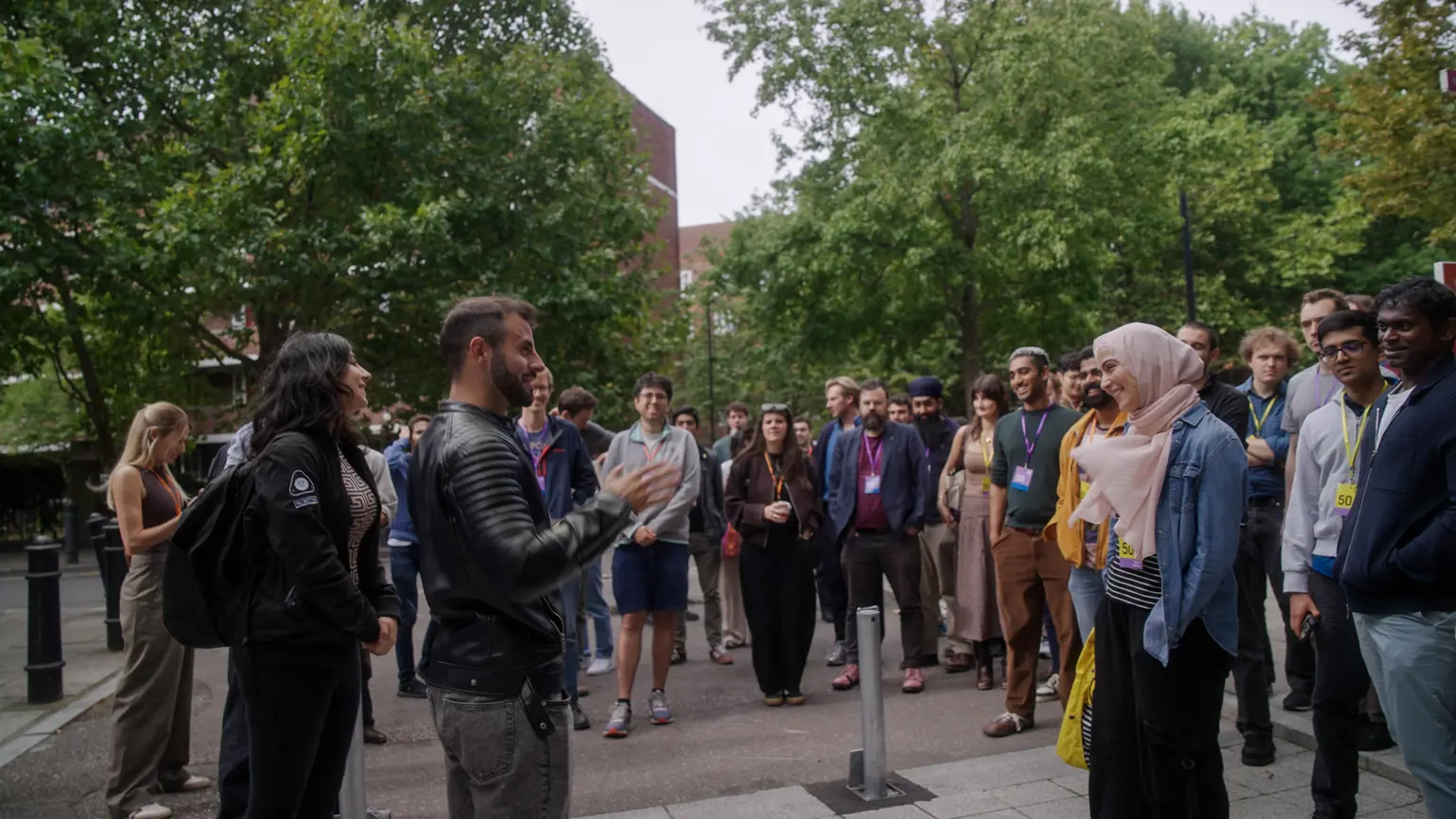
Our Activation Partner Fifty Years’ 5050 UK programme helps scientists and engineers test whether an ambitious research idea should become a venture — and what it takes to make that leap.
A promising research result does not always come with a clear route forward. A team may still need to decide what to test next, where the strongest first use case lies, how to handle IP, or whether a company is the right way to take the work further.
For some researchers, a company will be the right next step. For others, it will not. 5050 gives scientists and engineers space to test those questions alongside the technical work, before they are ready to launch publicly.
We spoke to Vaitea Cowan, the UK Lead at Fifty Years about what that process involves and how it's helped scientists and engineers start 28 companies, which have raised more than £30m since the first cohort ended in July 2025.
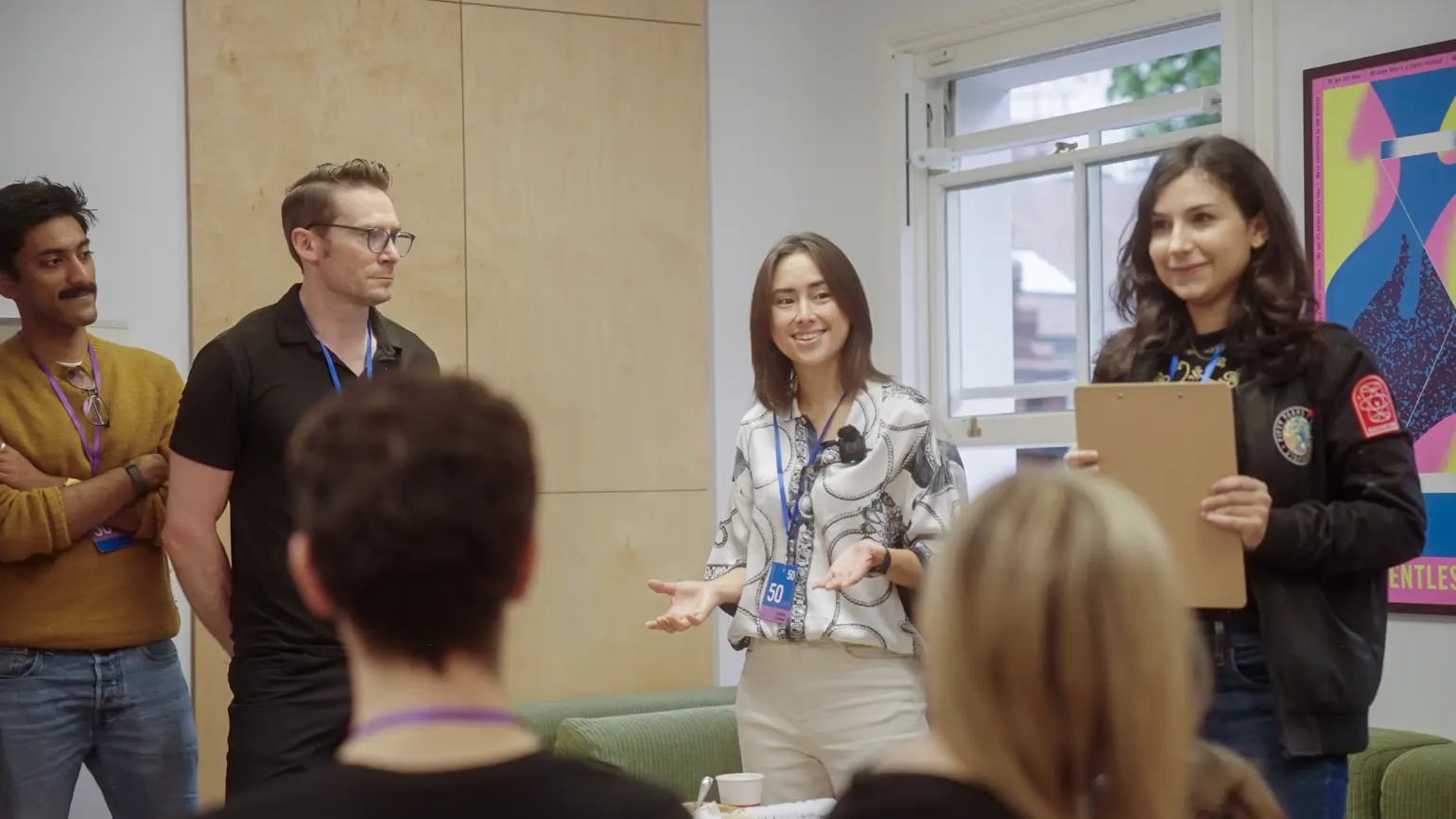
From left to right: Seth Bannon, Vaitea Cowan and Steph Avraamides from the 5050 team
A lot of attention goes to companies once they launch or raise funding. Why is the period before a company exists so important for ambitious scientific ideas?
“The period before a company exists is where some of the most consequential decisions get made: whether to start a company at all, how ambitious it could become, and what to build. Many extraordinary scientific ideas never become companies. We meet brilliant scientists and engineers who have never seriously considered entrepreneurship, often because they don't see themselves as founders. The first opportunity is helping exceptional scientists become founders of companies that might otherwise never exist.
It's also when ambition and direction are still highly malleable. A scientist might initially see their breakthrough as a tool for a narrow application, when it could become a platform play with greater scaling opportunities. At 5050, we challenge scientists to imagine the biggest impact their work could have, then work backwards to figure out what it would take to get there. Finally, early decisions matter even more in deeptech, where developing a technology can take years and a lot of capital. Choosing the wrong first market, or building a prototype before understanding customer needs will set a company back. Before those commitments are made, scientists have the freedom to test assumptions, explore applications and change course.”
When a researcher joins 5050 with an early technical insight, what does the work of exploring it actually involve day to day?
“Scientists already know how to form hypotheses, design experiments and challenge assumptions. At 5050, we help them apply that same rigour to figuring out whether there's a venture-backable company worth building.
Rather than committing to the first application of their research, we invite scientists and engineers to explore ten potential ideas, challenging each on its technical feasibility, customer need and commercial potential. We encourage them to try to kill ideas rather than confirm them. One of the first milestones is developing real conviction about which opportunity is worth pursuing. From there, they turn their biggest uncertainties into concrete technical and commercial milestones.
5050s are then encouraged to conduct 100+ customer discovery conversations. We teach them to investigate actual behaviour, like when a customer last spent money trying to solve the problem, rather than relying on hypothetical interest. The goal is to uncover real demand and use that evidence to decide what to build.
Each week, participants attend workshops and join group office hours. We work through specific blockers together, from understanding how to increase conversation outreach to identifying which first customer to get an LOI from out of the multiple conversations a 5050 is having. There’s also always the community of 500 other scientists and engineers in the UK and US, who’ve been through the same process. They can ask for introductions and share tips on how to get affordable lab space.”
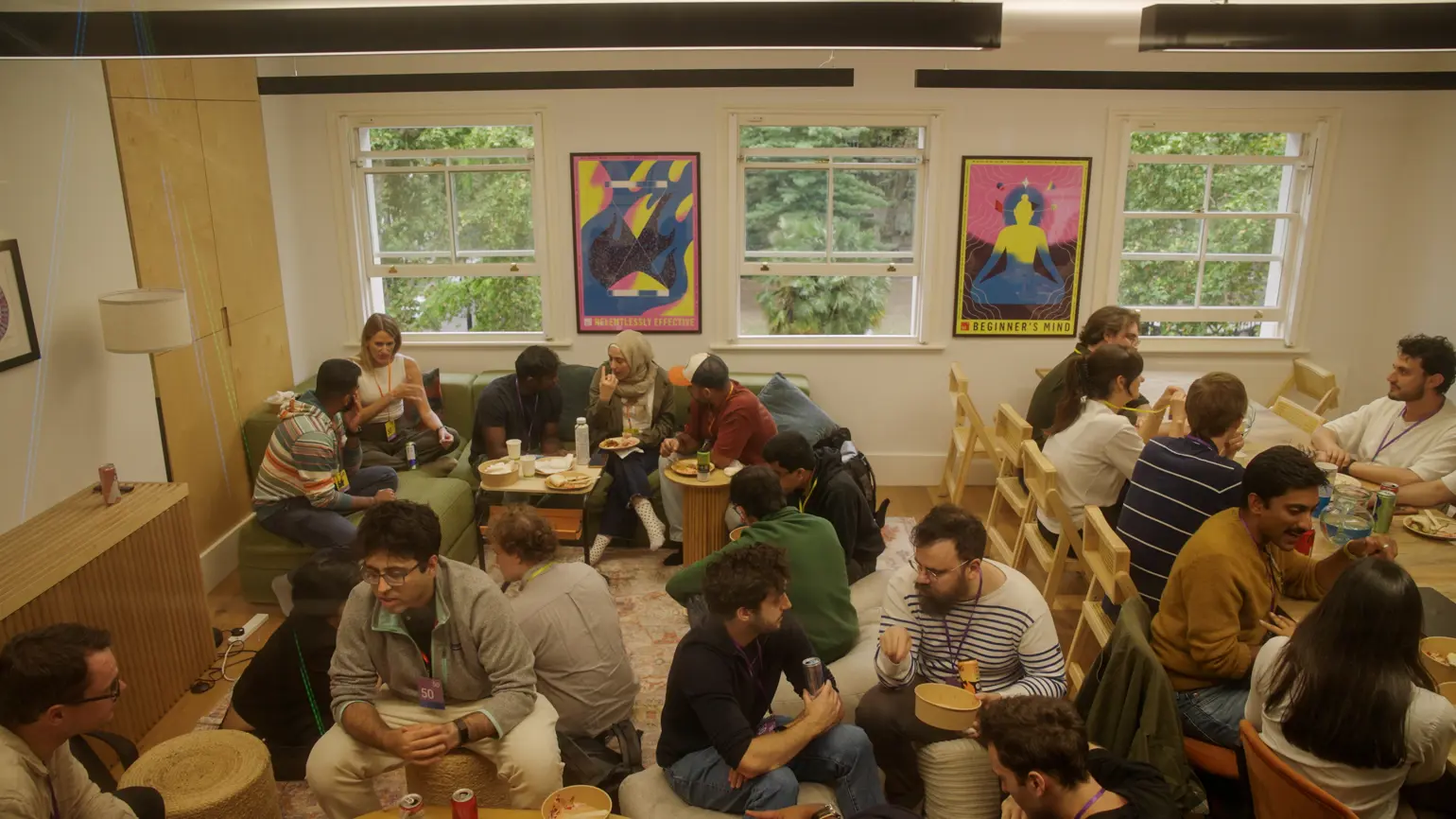
50Y team at cohort 4 kickoff in London.
What does company-building ask of a scientist that academic research does not, and what do you do to help them develop those new ways of thinking?
“One of the biggest shifts is learning that scientific evidence alone isn't enough to build a company. A scientist might ask, "What company can I build from my technology?" The correct question to start with is: "Whose problem is so important that they’re willing to pay me to fix it?"
While a scientist might naturally focus on improving the performance of their technology, it’s not unusual for a founder to discover through customer conversations that what they actually need is a cheaper, faster, or easier to use solution. The problem that needs solving determines which scientific milestones matter.
Another shift is learning to act before everything is certain. Founders have to recruit, sell, and raise capital while the science is still being developed. They need to communicate an ambitious vision while being clear about what has and hasn't been proven.
And perhaps the most personal shift is identity. Being a founder means stepping beyond your technical expertise. We've seen participants go from “I think I might want to build something” to seeing founding as inevitable. At 5050, we develop these instincts through practice. We make customer discovery non-negotiable, sometimes asking engineers to pause technical work until they've spoken to enough potential customers, and manage expectations that a 5-10% response rate at the start is normal.”
Many of the ventures are still building quietly. How do you think about impact at this stage, before there is a public company story to tell?
“We look for evidence that the biggest uncertainties are being resolved. We measure progress across four areas:
Technical de-risking: Has the team demonstrated something that materially changes what's possible? That might be a proof of concept, a successful experiment or a techno-economic result that addresses the questions customers and investors care about. One team showed their space technology could cut costs by up to 60 times.
Commercial de-risking: Are customers demonstrating real demand? We look at pilots, prepayments and letters of intent, but care much more about their substance than their number. One alumni team secured letters of intent representing over £18 million in potential commercial value.
Team formation: Has the scientist found the people needed to build the company? Have they found a complementary and committed cofounder, the confidence to build solo, or a first technical hire can change a company's ability to execute?
Funding readiness: We don't treat fundraising as the end goal. We work backwards from what the company needs to prove, and what capital is required to reach that milestone. The more uncertainty a founder can resolve before raising, the stronger their potential fundraising position. Out of the first three cohorts in the UK, 28 companies have been started, raising over £30 million since the first cohort ended in July 2025. Joining the 80+ companies started from the US 5050s.”
ARIA is interested in creating the conditions around ambitious R&D, not simply funding projects. What role can Fifty Years play in that wider ecosystem, and what are you hoping becomes possible next?
“I see this as complementary to ARIA. ARIA is pushing the frontier of what's scientifically and technologically possible. We're helping expand the pool of people who can turn frontier science into ambitious companies. In practice, that means connecting founders with ARIA's opportunity spaces, building relationships across both communities, and helping promising technical talent find the right opportunities.
The UK has world-class science, but we're still leaving an enormous amount of entrepreneurial potential untapped. Many exceptional scientists never seriously consider becoming founders, or don't see a clear path to building an ambitious company from their work. That's the gap we're trying to close. Our role is to create founders, often before there's a company, a commercial application, or even a decision to pursue entrepreneurship.
We also want to make this path accessible to scientists wherever they are. The UK has extraordinary talent well beyond Oxford, Cambridge and London, but access to entrepreneurial networks and capital isn't evenly distributed. That's why we're reaching researchers in places like Glasgow, Edinburgh and Manchester, as well as engineers in industry and scientists across Europe who could choose to build in the UK. And over time, this should compound. Each new cohort benefits from the experience and networks of those who came before it.
Ultimately, we'd love to see a UK where starting a company is as natural and credible a career path for an exceptional scientist as staying in academia. Our founders are already engineering enzymes with computational tools, produce critical ingredients for regenerative medicine in plants, and develop technologies that could remove cellular damage associated with aging. This gets us one step closer to realising the Star Trek future.”