
Who decides? Putting climate cooling governance into practice
Why governance is a vital component of climate cooling research, and how ARIA-funded studies are exploring how science can keep its place at the decision-making table
In summary:
Research into climate cooling is advancing, but there is still no agreement on who will decide whether it is used, who will control it, and on what terms.
For this reason, ARIA’s £56.8 million Exploring Climate Cooling programme funds governance research alongside science, to understand how decisions about deployment might play out in the real world, and how science can play a role in those conversations.
Two ARIA-funded studies led by the Centre for Future Generations showed that politics, strategic competition and state sovereignty tended to drive negotiations over climate concerns, and scientific experts were often overlooked.
They also hinted at where cooperation could begin, and at how a robust international independent evidence base, trusted voices and stronger monitoring capabilities could all be steps towards better informed decision-making.
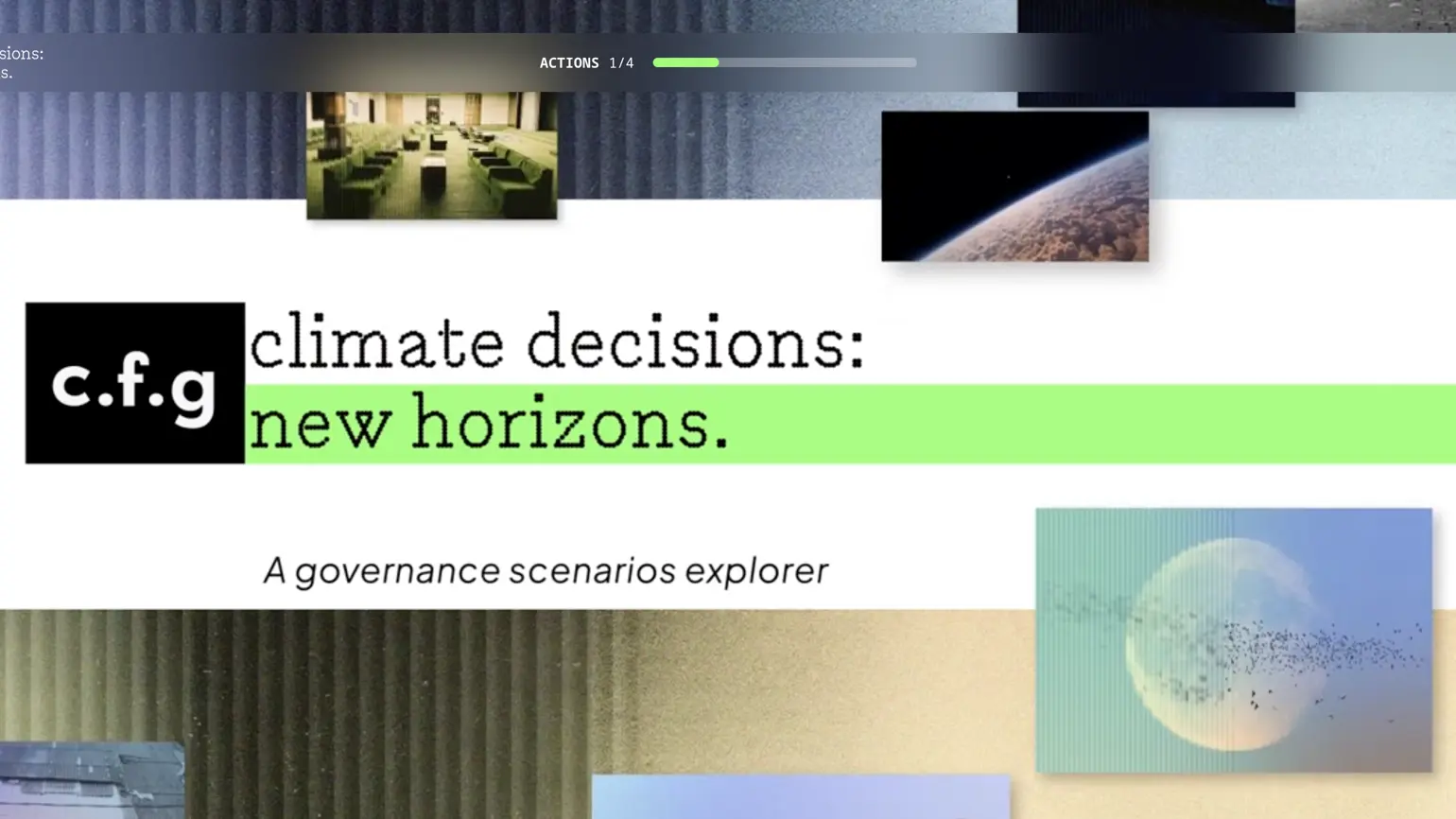
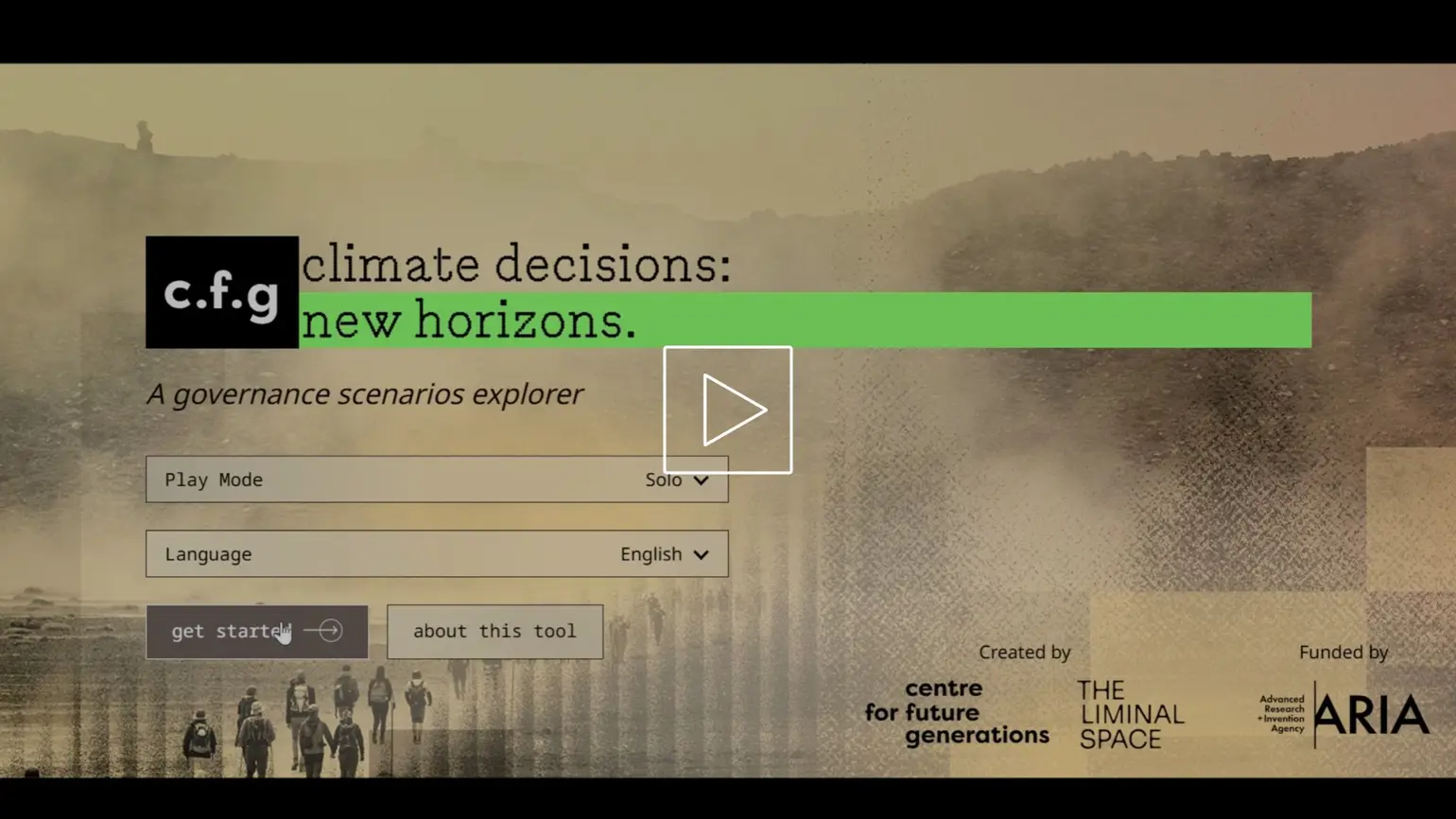
Play the game Climate decisions: new horizons to explore for yourself the trade offs between speed, sovereign interests and scientific knowledge.
Who decides?
One day in the not-too-distant future, a nation state or a private actor may decide to deploy a climate cooling technology. This technology holds potential to mitigate some of the worst effects of climate change, while decarbonisation happens. However, deployment in one region could have impacts on weather patterns across the globe. Despite increased public research funding from bodies like ARIA, the efficacy and impacts of these technologies aren’t yet sufficiently understood.
Important questions need to be answered before this future moment. Who gets to choose whether climate cooling technologies are used or not? Who decides when we know what’s effective and safe? Who will control their deployment? What are the conditions on their use? How can we reach international agreement on something which will have global ramifications?
"The real world is not optimal; any discussions around research and governance of SRM are set against the backdrop of current power structures and geopolitical dynamics. With the added complexity of commercial incentives and public perception, scientific research is increasingly coming into contact with all of these external pressures."
Colleen Golja
The challenges of governing a sensitive technology in a complex context is not unique to climate cooling. For example, governance of nuclear weapons, or AI safety, has run into similar obstacles: states worry about sovereignty, advantage, and who might act first. Finding common ground and agreement is exceptionally difficult.
Funding the hard questions
For these reasons, governance is a core component of the Exploring Climate Cooling programme, ARIA’s £56.8 million effort to build an independent evidence base on whether climate cooling approaches could ever be feasible, scalable, safe, and governable.
Exploring governance helps scientists understand what might happen when their science comes into contact with the outside world, and whether it will withstand the scrutiny and complexity of such sensitive decision making.
ARIA’s largest governance project, led by the Centre for Future Generations with the Australian National University Futures Hub, the OECD, and the University of Leeds, explores how climate cooling could be governed in different futures. It has recently published three linked pieces of work, built to put governance to the test in “real world” environments and understand the place of science in these discussions: four future scenarios, crisis simulations that put comparable governance pressures to the test, and an interactive game that lets players explore the trade-offs involved.
The scenarios.
Trish Lavery’s team worked with more than 250 policymakers, scientists, civil society representatives, and members of the public, plus 22 experts, to build four scenarios set in 2036. They imagine four different plausible futures in which stratospheric aerosol injection, a proposed method for cooling the climate, might shape political decisions within the next decade.
One explores how an international agreement on restraint is challenged under pressure. Another imagines a company preparing a large outdoor test. A third explores how misinformation could destabilise an Arctic research programme. The fourth looks at what might unfold when one country accuses another of preparing to alter the atmosphere, but no one can verify whether that’s true.
“You might never want to do geoengineering, but you might want to know what it means if it's done to you.”
Trish Lavery
The scenarios were not designed as predictions, but to provoke different conversations about tensions and trade-offs which might be faced. Setting them in the near term intended to show to policymakers that a decision could land on their desk during their own careers – and that factoring a strong scientific foundation into discussions would support negotiations.
The simulations.
The second piece of work ran three two-day crisis simulations, led by Danielle Young at the University of Leeds with colleagues at Queen Mary University of London and Imperial College London. In them, 35 international academics, civil society actors, policy experts and practitioners took on the roles of governments and other actors, each with their own aims and red lines, under conditions that mirrored today’s geopolitical tensions and dynamics.
In none of the three simulations could participants agree on a framework for governing stratospheric aerosol injection. Strategic competition and state sovereignty, not climate concerns, drove the negotiations. States leveraged lack of consensus over the distinction between research and deployment to protect domestic experimentation and maintain sovereignty. The scientific representatives in the room were frequently overlooked, particularly in the early stages of discussion, with misinformation allowed to run free to hamper consensus. Countries without the ability to generate, interpret and verify evidence could not participate on equal terms.
“These exercises show that evidence alone will not resolve political disagreement. But without independent research, monitoring and expertise distributed across countries, decisions with global consequences risk being made without the evidence needed to assess the claims at stake.”
Mark SymesProgramme Director
By looking for where governance breaks in a real-world setting, the simulations surfaced obstacles that abstract analysis tends to miss. The exercise showed that shared research principles, investment in scientific capability and better monitoring could provide starting points for cooperation. You can read the full report on the simulations here.
The game.
Drawing on the tensions explored through the scenarios, CFG created an interactive game, Climate decisions: new horizons – in which players take the role of head of state of an imaginary country facing a decision about a climate cooling technology. They must balance sovereignty, alliances, and public trust to try and find the best way forward in a complex landscape.
What comes next
For ARIA, these pieces of work surface one of the strongest arguments for public-interest research. Research and monitoring cannot remove geopolitical tensions from the picture. But they can give more countries the evidence and expertise to assess claims for themselves, participate meaningfully in decisions, and hold others to account.
“Investing in shared knowledge — including research, monitoring and attribution — is not just technical groundwork. It helps us understand what is happening, assess the consequences of unilateral action and build the basis for cooperation.”
Matthias Honegger
The reports point to a set of next steps to support complex conversations.
Build independent knowledge & a trusted source of truth. Public funding for research introduces independent evidence into the conversation, and lets decision makers interpret the science for themselves.
Talk to the public early. Engaging people late, on terms set by others, leaves the field open to confusion and distorted narratives. Building awareness and understanding about interventions helps conversations to happen early – not just at the policymaker level.
Bring more voices into the room. The climate and security communities risk having siloed conversations about this technology. Climate discussions often centre on moral hazard, equity and the choices left for future generations. In security settings, those concerns rarely arise as attention shifts to sovereignty, advantage and control.
Know what is really happening in the atmosphere. Independent monitoring and attribution is useful whatever position you take. When evidence is contested, different interpretations can prevail.
Keep testing. The game comes with a facilitation guide that lets policy teams stress-test their own governance options. Running the simulations again under different starting conditions, such as a different international order, would also help to shed more light on how different parties respond in different situations.
As a first step, play the Climate decisions game to test how you would balance scientific evidence, sovereignty, alliances and public trust under pressure.
Related articles
New voices, new questions: climate cooling research in Sub-Saharan Africa
Key takeaways from the 'Empowering New Voices in Climate Cooling' workshop
Read more
Building the human pathway for climate tipping point warnings
Meet the inaugural cohort Forecasting Tipping Points Fellows
Read more
Exploring Climate Cooling: a year of progress
Mark Symes provides a status update on the programme
Read more