
30 January 2026
Backing great scientists to build world-changing companies with Fifty Years
Learn more about our Activation Partner’s flagship programme and what it has achieved so far.
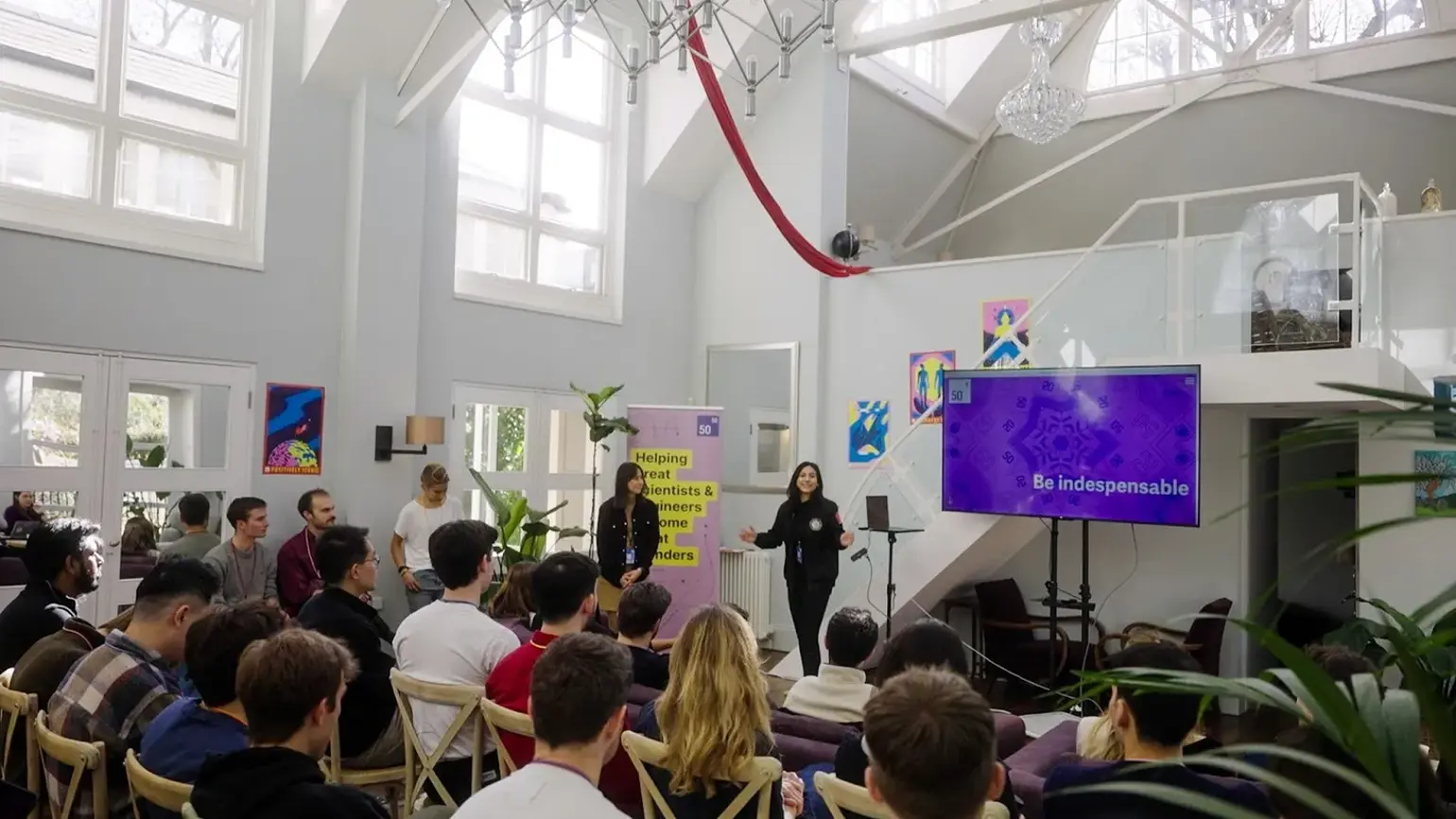
5050 UK cohort 1 kick-off weekend in London. Credit: Fifty Years
Our Activation Partner Fifty Years is a company builder and pre-seed to seed focused VC firm backing researchers pursuing breakthrough technologies to solve the world’s biggest problems, from the climate crisis and life-threatening diseases to connectivity and malnutrition. When applications opened for the third UK cohort of their flagship 5050 programme, we dived into what they’ve achieved in the UK so far as a result of our partnership and how scientists and engineers can get involved.
Together with ARIA, Fifty Years launched the 5050 programme in the UK — an equity-free deep-tech company builder supporting scientists and engineers to take research from the lab into world-changing companies, whether they’re ready to build or still exploring if entrepreneurship is right for them. “The UK has four of the top 10 research universities in the world, but a deep tech ecosystem roughly the size of Palo Alto’s,” says Seth Bannon, Founding Partner at Fifty Years. “It might be the largest gap in the world between the calibre of talent and the robustness of the deep tech ecosystem. 5050 aims to close that gap.”
Just over one year into our partnership, 5050 has unlocked exceptional latent technical ambition from around the UK. Across the two cohorts, they’ve supported 86 scientists and engineers to found 26 deeptech companies that have raised a combined £7.75m+ to take R&D from the lab to civilisationally important companies. “We’ve been incredibly excited by the quality of the talent,” says Steph Avraamides, UK Lead at Fifty Years. “ARIA has been an amazing partner for us in the UK, making it possible for us to launch about five years earlier than we otherwise could have. The alignment’s been strong from the start – both teams care deeply about ambition, speed, and backing work that actually matters. That’s shaped who we recruit and the ventures that come out of the programme.”
Prospective founders join 5050 with unique technical insights in fields spanning ARIA’s opportunity spaces – from robotics to synthetic biology and immunology – with many working at the intersection of multiple disciplines, benefitting from the intra-cohort collaborations 5050 enables. A specialised AI safety track formed around our Safeguarded AI space has brought in as mentors the co-founders of OpenAI, Anthropic, and the Future of Life Institute to advise on how AI alignment research can reach the labs and systems needed to maximise impact. “I joined 5050 while finishing my PhD in multi-agent AI systems, with my experience almost entirely in academic research.” says David Hyland, Postdoctoral Research Associate at the University of Oxford. “The programme filled in critical gaps I didn’t know I had – from identifying meaningful markets to de-risking technology and building real partnerships with customers and investors. 5050 reshaped how I think about translating AI research into companies that move AI safety from papers into practice.”
Many come into the programme as ‘entrepreneurially curious’, but doubtful over whether their research can create a globally-impactful startup, whether founding a startup is for them, or how to begin pursuing it. One UK researcher working around the Manufacturing Abundance opportunity space joined the programme unsure they were ready to found a company, and sceptical that their idea could attract venture funding. They have since raised £1.5m and are now building full-time in London.
“What’s often missing isn’t ability – it’s confidence and permission,” says Seth. “Many researchers don’t initially see their work as venture-scale, or assume starting a company isn’t for them. Once that mindset shifts, things can move very quickly. The UK felt particularly ready for that kind of push.”
Applications for this programme are now closed.