
30 January 2026
Robot hands with human capabilities
As a Creator in the Robot Dexterity programme, Udayan Bulchandani and his team are building a bio-inspired robotic hand with dexterous manipulation abilities far exceeding what’s possible today. We caught up with Udayan to learn more.
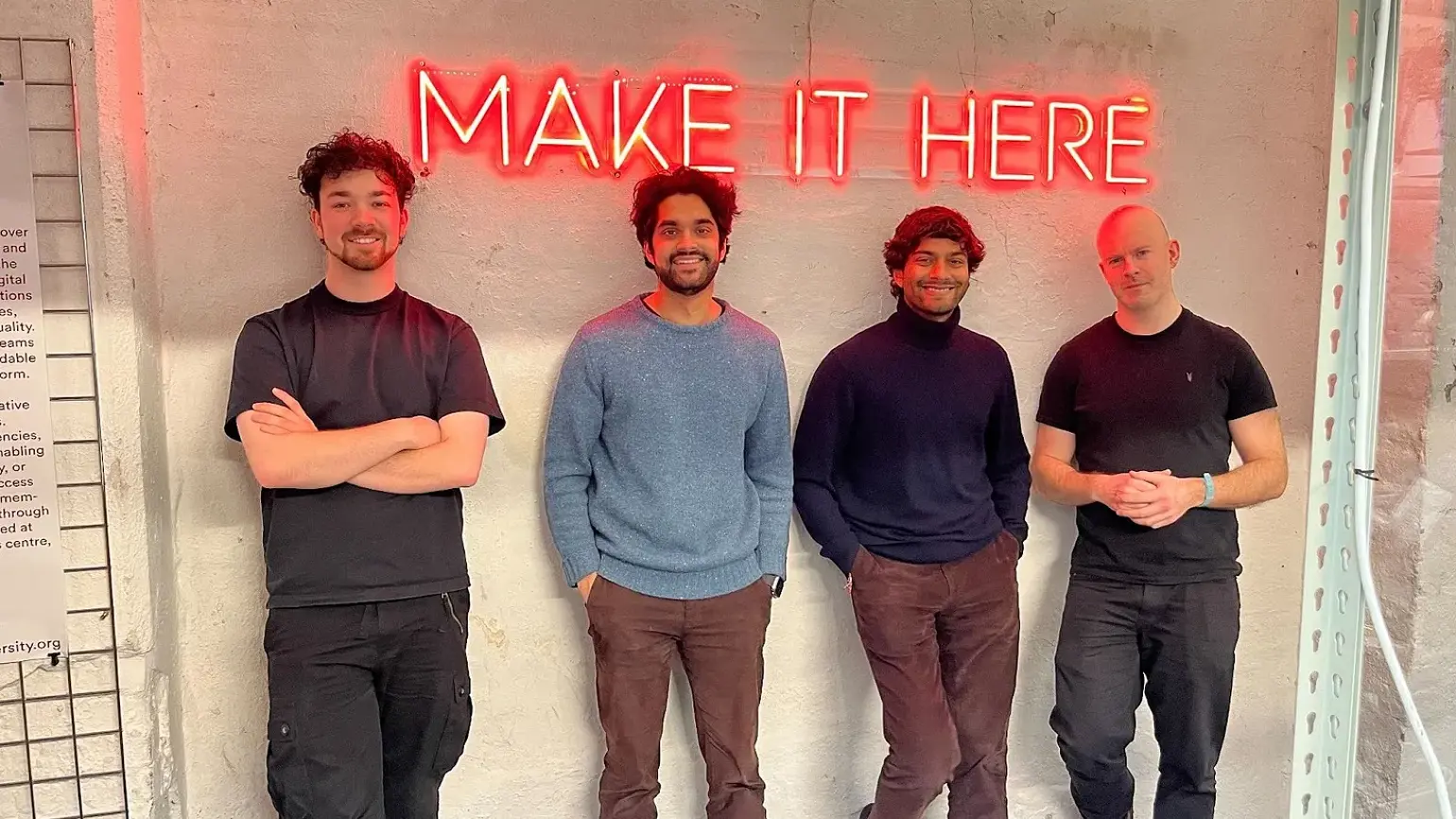
The Arthur Robotics Ltd team (from left to right: Julian Ing, Udayan Bulchandani, Alekshandra Sinha, Edward Owen). Credit: Arthur Robotics Ltd.
What are you currently working on?
We’re building robotic hands inspired by human hands, with the goal of achieving human-level dexterity for industrial robots. Many tasks that humans can do almost effortlessly are extremely challenging for robots today, from handling delicate and irregular objects like pieces of fruit or sheets of cloth, to working with flexible electrical cables. Automation is only possible at prohibitively high volumes, and requires expensive one-off machinery.
The human hand is an extraordinary piece of hardware, and we believe it’s the key to understanding dexterity. The powertrain – the complex of muscles, tendons, ligaments, and bones that we use to move our fingers – is remarkably lightweight, allowing for rapid yet highly precise movements. We humans have a highly sophisticated sense of touch, with distinct types of touch receptors each contributing a different ‘feel’ – and that sensing lies in a very thin layer that sits seamlessly on top of the mechanical elements.
Previous attempts to combine all this together have typically yielded robotic systems that are bulky and still very far from matching the capabilities of the human hand. To bridge that gap, we have to simultaneously push the frontiers of material science, sensing, and actuation, whilst developing new robot learning methods tailored to that system. This is the core problem we’re tackling. We’ve recently completed our first robot hand prototype and it’s been amazing to see some of the human-like abilities that have already emerged.
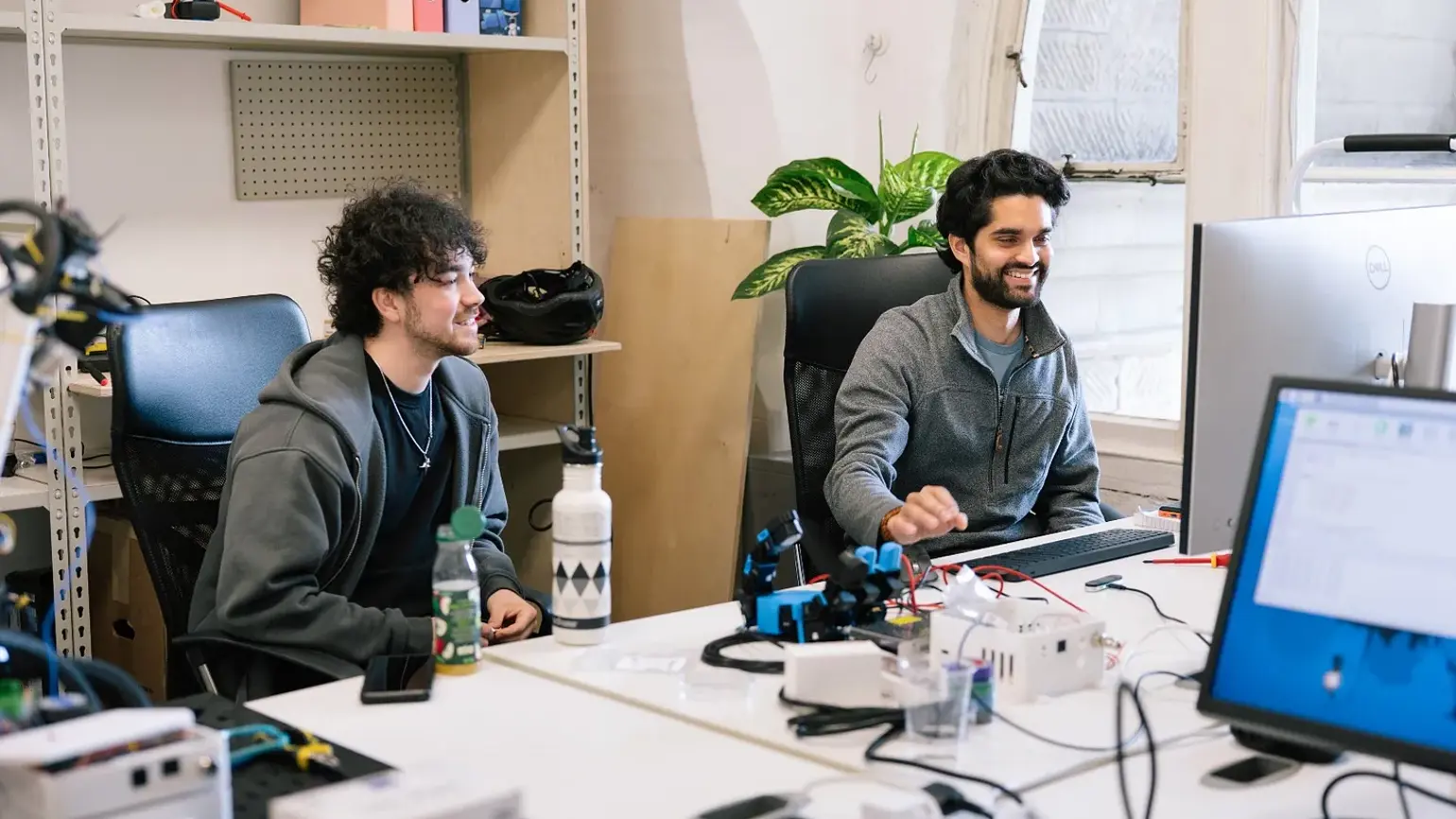
Julian and Udayan in their lab space at Makerversity, Somerset House, London. Credit: Arthur Robotics Ltd.
What do you wish more people knew about your research area?
The difficulties we encounter in robotics are probably not what most people expect. For example, building a ‘humanoid’ robot – one that can walk around on two legs, and has two arms and two hands with fingers and opposable thumbs – has actually been possible for decades. The reason we don’t see robots everywhere is because of fundamental capability gaps that aren’t immediately apparent to the naked eye. Dexterity is one, safety is another.
Interestingly, solving these problems will likely impose relatively few constraints on the overall form factor of the resulting robot, and this is where envisioning the future of robotics gets really exciting. We’re only just starting to scratch the surface of how real-world general-purpose robots might look, and considerations like unit economics and efficiency are not yet driving design decisions.
Many people might also be surprised by just how accessible the field of robotics has become in recent years, even for the casual hobbyist, with small, integrated motor units that are easy to control from an Arduino-type board being widely available at reasonable prices. Combined with a robust software ecosystem and the availability of inexpensive 3D printers, it’s possible to build a desktop-scale robot arm for a few hundred pounds. This arm might not achieve frontier levels of dexterity but its capabilities are still impressive, especially when paired with recent AI models. That’s a fantastic starting point for anyone who’s interested in learning how robots work.
If the technology you’re building is wildly successful, what’s the most ambitious application you could imagine for it in, say, 15 years’ time?
There are so many examples that come to mind, but here are the ones I think about most often:
- Significantly more capable prosthetic hands. The dexterous ‘intelligence’ that we’re building for industrial robots could be transferred into a prosthetic hand – capable of using environmental cues and its own control loop – to unlock a huge range of delicate, contact-rich tasks.
- Dramatic reductions in landfill waste. Large amounts of today’s landfill could be sorted, deconstructed, and usefully recycled, but the amount of manual labour required is hopelessly uneconomical. Greater robot dexterity could solve this – disassembling any consumer product in seconds and allowing precious and rare elements to be repurposed.
- Hyper-local supply chains, enabled by general-purpose factories full of dexterous robots, that can efficiently produce a single unit of a highly complex product. This would prevent unsold stock piling up in warehouses, drastically reduce shipping miles, and allow customisation of almost any product.
- A worldwide clean-up of outdoor waste plastic from large land areas, waterways, and ocean floors. This would require manual dexterity on a massive scale, and given the millions of tons of new plastic waste that accumulate every year, robots seem like the only viable solution.
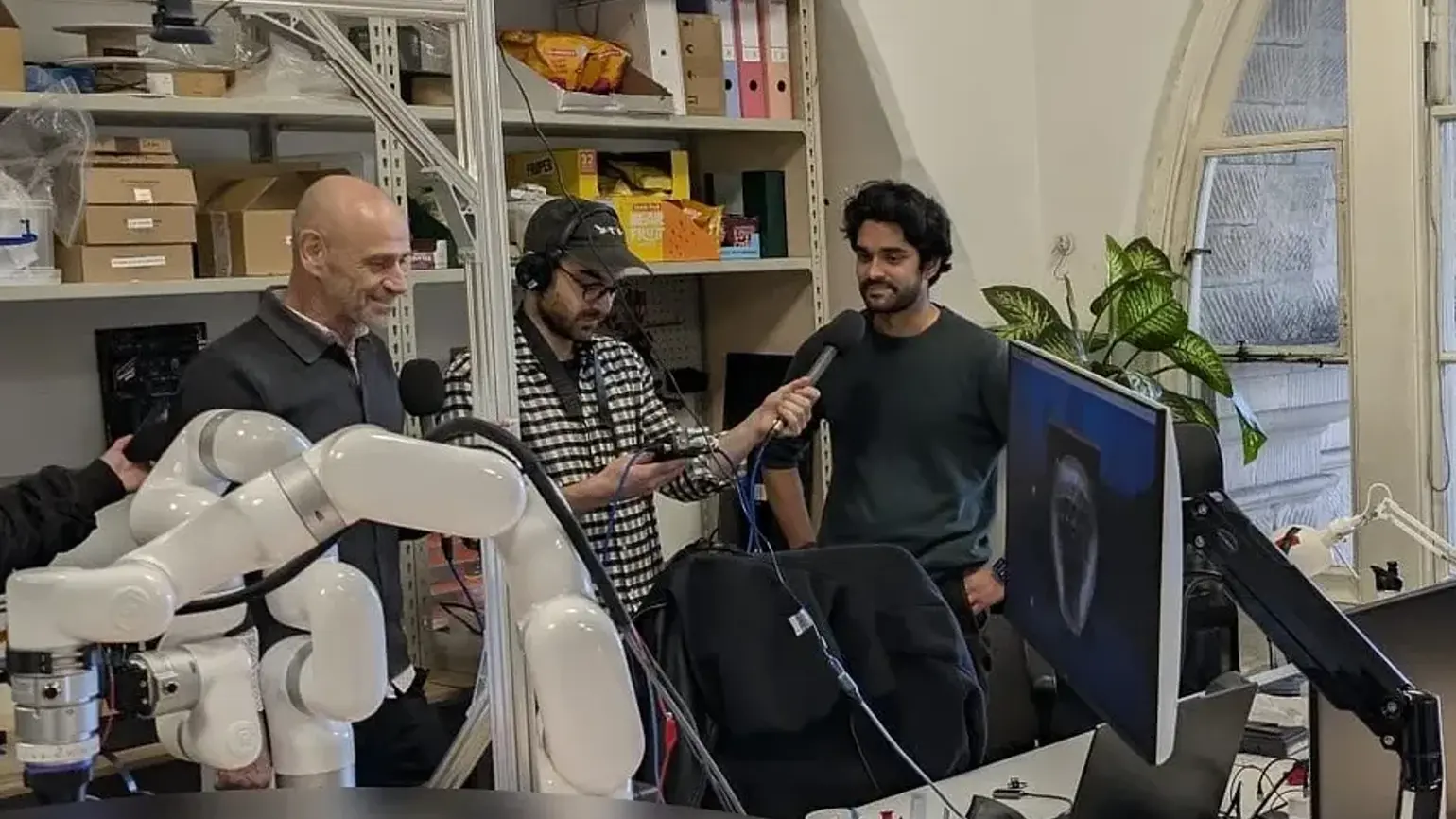
Udayan being interviewed by Evan Davis for Radio 4’s Inside ARIA documentary. Credit: Arthur Robotics Ltd.
And finally, which book/film/TV show should people check out to understand your project or discipline more?
The Hitchhiker’s Guide to the Galaxy by Douglas Adams. Like all great works of literature, it features some wonderful robots (Marvin!). The book overflows with a wonderfully imaginative view of a futuristic civilisation transformed by technology, whilst simultaneously imbued with a healthy dose of scepticism around whether that technology will be used in sensible ways. Our company is actually named after the book’s protagonist, Arthur Dent, whose stoicism in the face of galactic-scale chaos inspires our own approach to research. We have a clear view of the problem we want to solve and the mechanisms needed to solve it. Regardless of what distractions might appear, like Mr Dent, we’ll head to our lab, have a cup of tea, and get on with it.
Discover the funded projects in the Robot Dexterity programme