
15 April 2026
Robot Locomotion: a possible ARIA programme
Programme Director Jenny Read, reveals her thinking around a second programme in the Smarter Robot Bodies opportunity space.
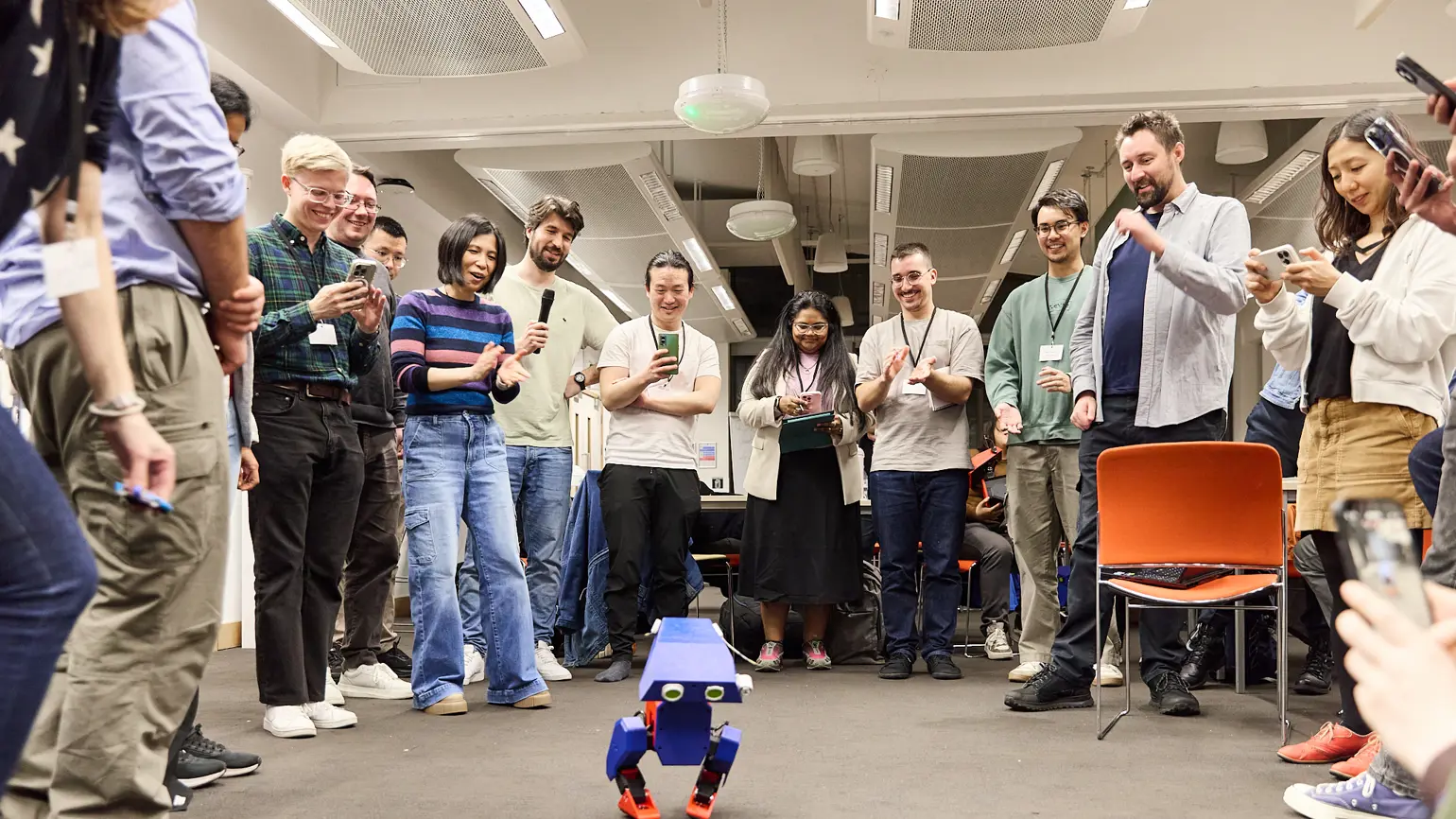
Creators on the Robot Dexterity programme (Photo Credit Amy Birch)
The challenge
Every year, thousands of people walk the Yorkshire Three Peaks: 24 miles over rough ground, carrying food, water, and spare layers. We don’t appreciate enough how extraordinary that is. Humans can cross mud, rocks, or steps, in rain or shine, and do it all on compact fuel, quietly. Ask a robot to do comparable work whilst carrying useful tools, and the gap between today’s machines and biology becomes obvious. Animals still outperform robots on the combination of agility, range, and robustness that real-world locomotion demands.
That gap matters because much of the physical economy happens beyond the flat floor of a factory or warehouse. If robots are to help build, maintain, inspect, deliver, restore, and repair in the real world, they must be able to move through places that were not designed for them: steep ground, broken surfaces, cramped plant rooms, high winds, soft soils, waves, rain, and clutter. Until then, robots will remain confined to prepared environments, near charging points, and with short operating windows.
At ARIA, we think this is a body problem as much as a brain problem. Perception, planning, and control are advancing rapidly but many of today’s robots still fight physics. They rely on stiff, power-hungry actuators. They spend too much energy holding themselves up. They imitate compliance in software instead of benefiting from it mechanically. Animals do the opposite: they store and release energy elastically, exploit resonance, distribute function across body and controller, and use the environment, rather than treating every disturbance as an error to suppress.
This is where locomotion comes to the fore. One useful way to think about locomotion is simply to ask: how much energy does it take to move a kilogram of useful payload over a given distance? Wheels can be astonishingly efficient when the world has already been paved for them. The harder challenge is efficient movement across the world as it actually is: unprepared, uneven, and dynamic.
Our first funding programme within the Smarter Robot Bodies opportunity space focused on dexterity: giving machines the physical intelligence to handle arbitrary objects with strength and precision. We now believe locomotion deserves the same kind of hardware-led effort. By locomotion, we mean getting from A to B by walking, climbing, jumping, flying, swimming, or by combining several modes.
Success requires solving the whole stack at once: actuators, structures, transmissions, materials, energy storage, thermal management, sensing, control, and the interfaces between them. Improvements in one part often make another worse. Startups struggle to finance long hardware cycles before product proof. This is exactly the kind of gap ARIA exists to tackle.
Why it’s worth shooting for
A step-change in robot locomotion, especially combined with dexterity, could unlock valuable new markets and make robots useful in parts of the physical world that are currently inaccessible.
Quiet aerial logistics and maintenance. Delivery drones are now real, but current commercial systems remain tightly constrained on payload, range, wind tolerance, and noise. Exciting use-cases currently being piloted, like transporting blood samples between London hospitals, could be greatly expanded if drones could carry higher payloads over long distances on a single charge and land without disruptive noise and downwash. For example, this could enable rapid autonomous delivery of emergency supplies in rural areas, where road response times are long and air ambulances are reserved for the most serious cases.
Ground delivery and service logistics. Today’s last-mile autonomous delivery robots are proving there is real demand, but currently these wheeled bots are limited to flat pavements and accessible surfaces. A robot that could handle kerbs, gates, steps, gravel and mixed indoor-outdoor routes whilst carrying a substantial payload could unlock new markets in hospitals, campuses, care settings, and industrial estates.
Climbing inspectors and repair robots. Some of the most valuable assets in our economy are physically awkward to reach: bridges, rails, ship hulls, offshore structures, and wind turbines. Robots that can cling to, crawl, and transition across complex surfaces could inspect and eventually repair these assets with fewer shutdowns, less rope access and lower risk to workers. Early inspection robots already exist, but the opportunity is to make them far more capable, durable and commercially deployable.
Aquaculture and offshore robotics. We are also interested in robots that move through water or at the air-sea interface. In aquaculture and offshore settings, the commercial challenge is long-endurance autonomy in currents, around nets, cages, moorings, and other complex structures; autonomous inspection and cleaning; useful work without repeated retrieval; and docking or recharging without human babysitting. A robot body that works with waves and flow, rather than constantly fighting them, could reduce diver time, vessel call-outs, and operational disruption.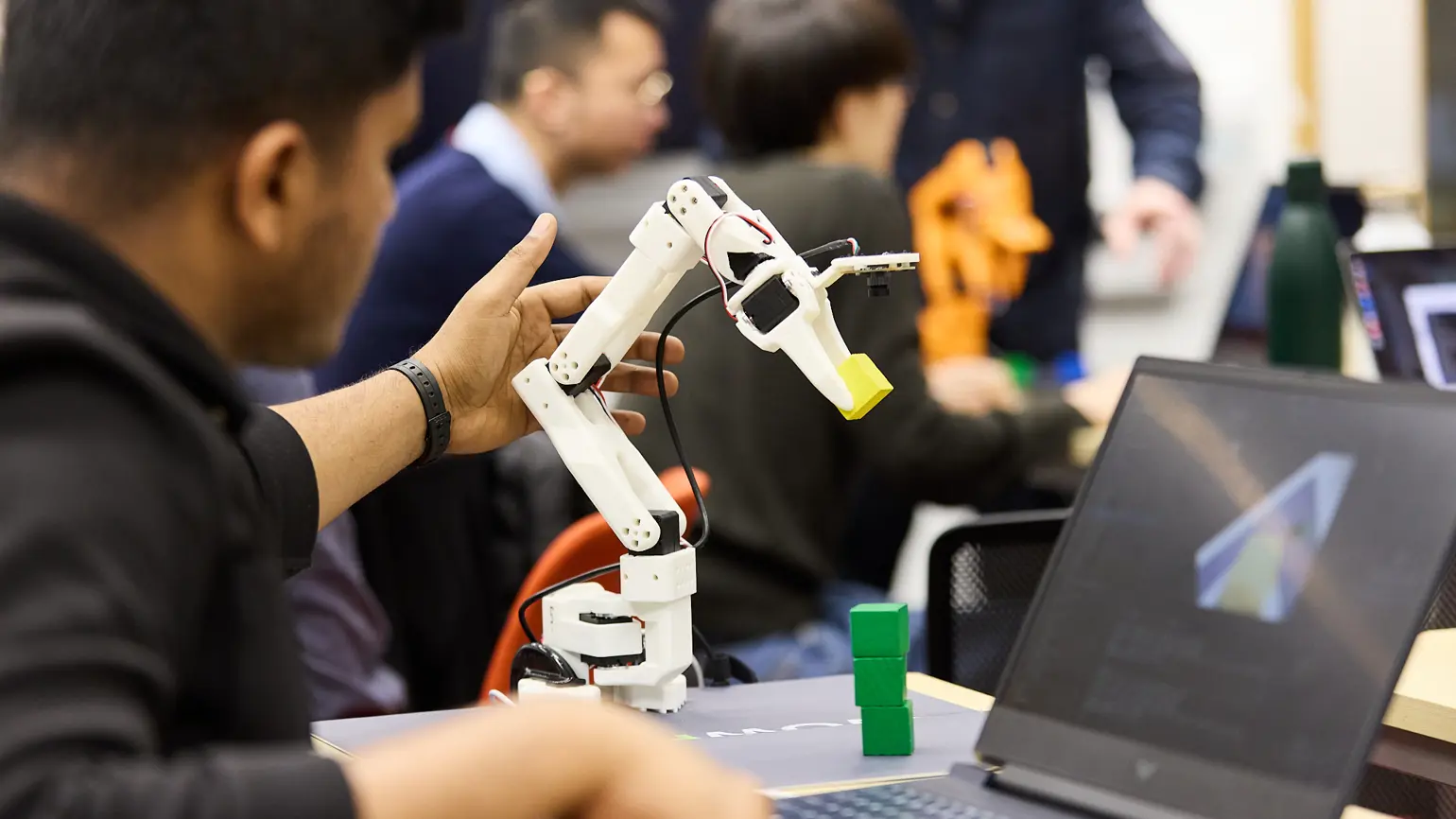
Creators on the Robot Dexterity programme (Photo Credit Amy Birch)
Potential programme
We believe these future robots will require advances in hardware. The most interesting routes may include elastic actuation, resonant wing- or fin-driven platforms, new transmission architectures, passive stability, compliant structures that survive impacts instead of merely avoiding them, or systems that harvest useful energy from the environment such as wind, thermals or waves. Different applications will require different trade-offs and different conditions for success. That is why we do not want to prescribe a single robot architecture or a one-size-fits-all end goal.
Instead, we envisage backing a small number of ambitious teams to build whole platforms around a clearly defined market need, alongside the critical components needed to make those platforms possible. Success should be provable in the field, not just in a lab. Teams should define the metrics that matter for their application — whether that is payload moved per unit energy, hours between charges, noise footprint, damage tolerance, operation after partial failure, or performance in wind, surf, or rough ground — and then beat today’s state-of-the-art on those terms. By the end of the programme, performance should be demonstrated head-to-head in realistic operating conditions, against incumbent approaches or current state-of-the-art systems.
We want this programme to create real-world benefit for the UK and the world, which means building in commercial focus from day one. That means project leads should be startups, companies, or company-forming teams with a credible route to a product, a pilot customer, and further investment.
This is a high-risk area. Some of the components we would need may not yet exist. Some of the most promising ideas may look strange at first. Some bets will fail. But if we can help create robot bodies that work with physics rather than against it, the payoff could be enormous: machines that can finally move through the real world with useful payloads, long endurance, and the toughness that real work requires.
What next?
If you are building components or systems that point in this direction, we would like to hear from you. Questions we are asking ourselves include:
- Which applications are commercially blocked today by locomotion hardware rather than by AI?
- Which technical metrics would genuinely matter to customers?
- Which missing components or body architectures could create a step-change?
- Which UK teams could credibly build and commercialise such systems?
Because strong proposals may require close collaboration across components and systems, we encourage interested parties to consider how they might form partnerships now. We plan to launch a teaming tool to support this – interested parties can use the tool to be introduced to others with required expertise to submit a joint application.
We are holding a programme workshop this summer to refine the thesis ahead of any solicitation, and to help promising teams find each other and develop ideas.
To explore our latest thinking on robot locomotion, visit our programme development page, where you can read our emerging programme thesis, share your feedback and/or to express interest in attending the workshop.
See how the programme is developing
You can also sign up for updates on our website and follow our LinkedIn page to be notified about future opportunities in this area.