
Re-thickening Arctic Sea Ice (RASI)
The Arctic is warming much faster than the global average, driving sea ice loss that threatens local ecosystems and accelerates global climate change.
While the only sustainable, long-term way to slow Arctic warming is through emissions reductions, the speed of Arctic warming has led to suggestions that deliberately thickening sea ice during winter might help to slow the melting and the rate of sea ice loss.
By bridging the gap between theoretical models, laboratory studies and real-world data collected through small-scale outdoor experiments, this project will investigate whether this approach could ever be feasible, scalable, and ecologically sound.
Overview
Led by Shaun Fitzgerald at the Centre for Climate Repair (University of Cambridge), the RASI project is supported by a £9.9m grant over 42 months. The consortium unites specialised field teams — Real Ice and Arctic Reflections — with a global network of research partners including the University of Manchester, UCL, the University of Washington, and NERSC, to combine rigorous scientific modelling with real-world Arctic experimentation.
Two separate sub-teams of researchers (Real Ice, Arctic Reflections) will conduct controlled, small-scale experiments in two locations in Canada. These experiments have been designed in close collaboration with local communities and in compliance with ARIA's stringent governance framework. The goal is to gather essential real-world data to rigorously assess if this intervention warrants further consideration.
Methodology
The outdoor experiments will take place in Nunavut, Canada, across three winter seasons (2026 to 2028). Using both above-ice and submersible pumps, the team will try to create thickened ice patches by pumping seawater from beneath existing ice and spreading it on top, where the frigid air freezes it quickly. Over the course of the project – and only if the early experiments suggest the approach is ecologically sound – later experiments will aim to cover areas up to 1 km² per experiment site. In the process, the RASI team will generate real-world data on variables that theory cannot yet predict – including whether this thicker ice lasts longer into the summer, how ice movement might be affected, and what the local ecological impacts of thickening might be.
In parallel, the RASI teams will look to reduce uncertainty around efficiency and scale. Data from outdoor experiments will feed into computer models to simulate interventions at scales that are not being physically tested. The RASI teams will model targeted interventions at natural choke points such as the Nares Strait – specifically, thickening ice arches. The goal is to understand if strengthening these specific areas could slow the flow of ice from the Arctic Sea into the warmer Atlantic, which is happening earlier and earlier in the year as the Arctic warms.
By collecting ice cores and water samples for study, the teams will look to improve our current understanding of whether sea ice thickening is ecologically sound. This real world environmental data will contribute to the wider programme, as scientists working on ecological modelling will then be able to simulate any ripple effects on the marine ecosystem, ensuring that the ecological cost-benefit analysis is understood before any large-scale activity is ever considered.
Research
The first phase of ARIA funded outdoor research begins in early 2026 at two locations in Nunavut, Canada. In both locations, the teams have secured Free, Prior and Informed Consent from the communities where this research will take place, ensuring engagement is meaningful, respectful and continuous. The researchers have secured the support and cooperation of municipal authorities, local Elders, and Hunters and Trappers Organizations (HTOs). Local residents have not only provided input into the experimental design but will also work alongside the researchers as part of the team.
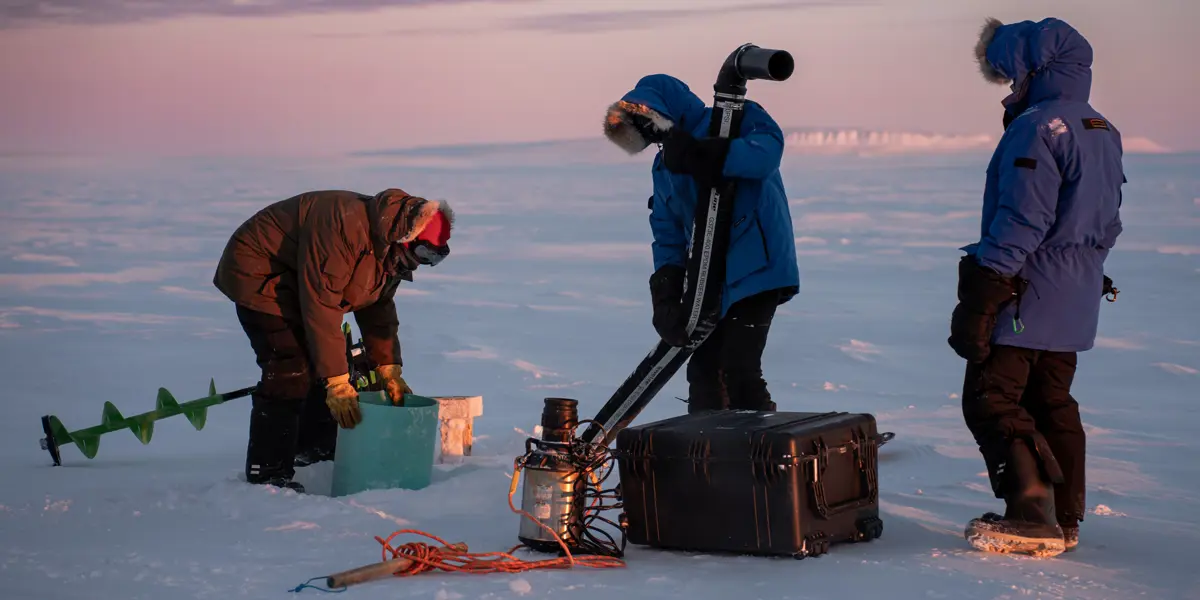
In Cambridge Bay, Nunavut, the Real Ice sub-team will commence work in mid-January. Building on two years of engagement with local residents, and subsequent iterations of the experimental design, the team has been granted their formal permit to operate. The experiment site, located ~7km from the hamlet, was selected together with the Ekaluktutiak HTO, and their members will take part in the project.
(Real Ice team members in Cambridge Bay, Winter 2024-25, courtesy of Elise Imbeau)
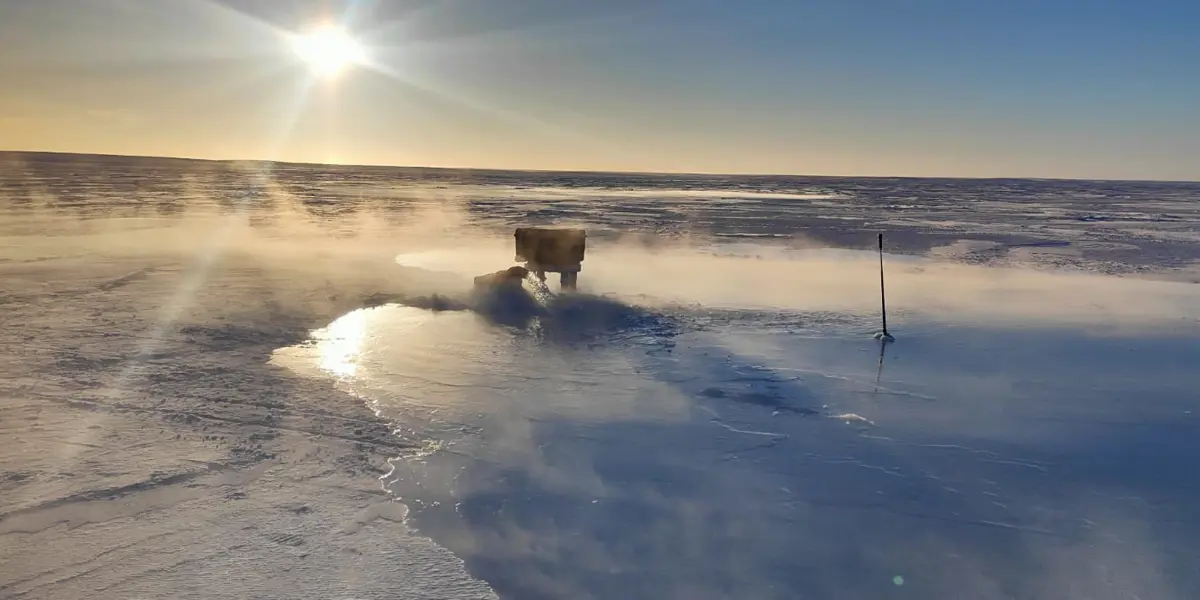
In Qikiqtarjuaq, the Arctic Reflections sub-team will commence work in early February. They have the support of key local stakeholders and have been granted the formal permit to operate. Following a pivotal consultation with the local community in September 2025, the team moved their proposed experiment site to a new location to avoid disturbing seal birthing areas, acting directly on the advice of local Elders and the Hunters & Trappers Organization.
(Real Ice research site in Cambridge Bay, Winter 2024-25, courtesy of Centre for Climate Repair)
Governance + oversight
RASI’s experiment and community engagement plans have been rigorously scrutinised by the programme’s independent Oversight Committee and subsequently approved to proceed by ARIA’s CEO. You can read the Committee's full recommendation here and the CEO's formal decision letter here.
Research is proceeding under Nunavut’s well-established research permitting framework, which ensures research is ethical, responsible, and incorporates traditional knowledge.
Resources
Our goal is to build the open scientific knowledge base the world needs to make better informed decisions.
We’re committed to responsible stewardship, transparency, accountability + meaningful community engagement. Find out more about our governance principles, the programme’s independent Oversight Committee, and the process by which outdoor experiments are scrutinised.
FAQs for RASI
Exploring Climate Cooling
This programme aims to build a robust evidence base to explore – with independent oversight – if climate cooling approaches could ever be feasible, scalable, safe, and governable
Funded projects
In Exploring Climate Cooling, we're funding 22 research teams uniting specialists across diverse disciplines