
30 April 2026
Term-limited by design
Exploring how our Programme Director model creates urgency and momentum.
From the moment they join ARIA, our Programme Directors are working against the clock.
They have a fixed window to define a vision, shape and fund a programme, and demonstrate progress in its pursuit.
This urgency does not sit with Programme Directors alone; it shapes the environment for our Creators, the researchers and teams that ARIA funds. Rather than operating independently over long timelines, Creators work within an actively managed system, with Programme Directors setting clear technical goals and redirecting efforts where needed, to make as much progress as possible in a tight window.
This draws on the ARPA model. Kathleen Fisher, our Chief Executive Officer, explains: “A fixed term is an invitation to be bold. I experienced it first hand at DARPA — a time limit accelerates your ambition and forces you to be decisive.”
Using time as a design piece
ARIA Programme Directors are typically in post for three-year appointments, with the possibility of a two-year extension.
“The term-limited nature of Programme Director roles creates urgency. Individuals step away from their usual work to lead something genuinely transformative at ARIA, and then return to their fields with the experience and perspective to tackle bigger problems,”
Muji Ahmedi
Product Operations Lead at ARIA.
Suraj Bramhavar, Programme Director for Scaling Compute, explains why this model was so compelling from the perspective of someone working in the field. “Prior to stepping into the role, I had been exposed to the ARPA model and the amazing technological progress it helped create. I had been in the throes of running a deep-tech spin out based on my own government-funded research, and experienced first hand the necessary tradeoffs between long-term impact and near-term profit. Continuing to push the field as a Programme Director at ARIA offered more creative freedom to operate, and a compelling perch from which to find even more impactful future research ideas.”
Using time as a design piece forces Programme Directors to cut projects that aren't working and double down on promising leads, and keeps the organisation itself at the frontier of science and technology.
A moment of transition
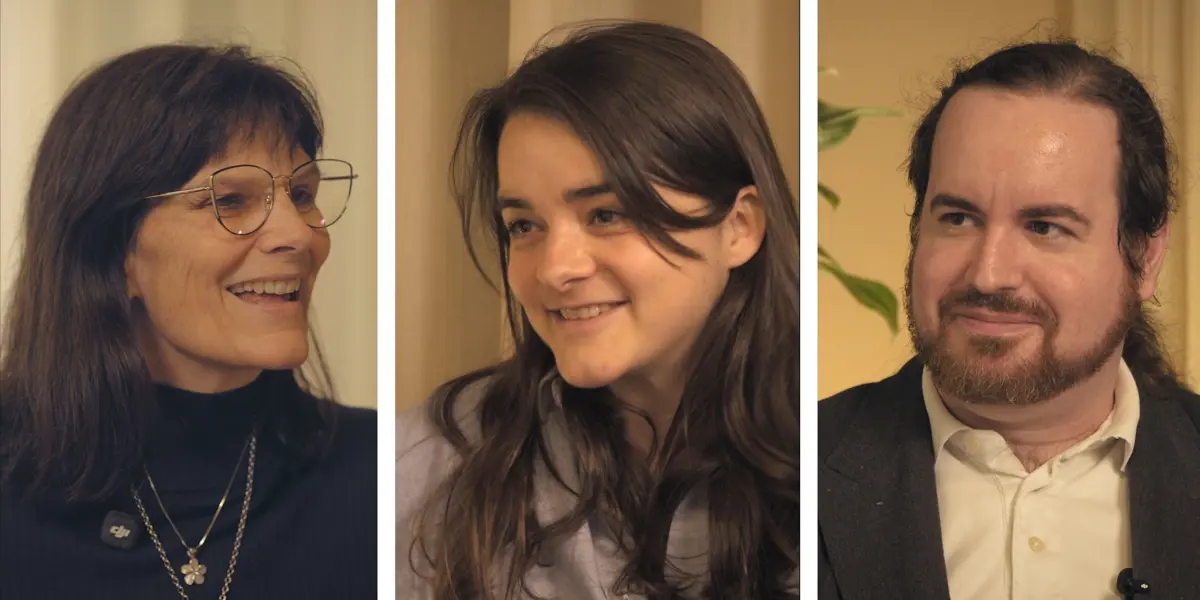
We recently marked a ‘PD transition’ at ARIA in our Safeguarded AI programme. Following almost three years leading the programme as Programme Director, davidad handed over to Nora Ammann, who has been closely involved in shaping the programme from the start as its Science + Technology Lead.
In most organisations, this would be a handover to stabilise, with leaders expected to carry an idea from its origins to its outcomes. But that assumes continuity is what produces progress. ARIA assumes something different.
Our programmes are designed to outlive their founders. As Nora takes over the Safeguarded AI programme, she inherits a community of Creators and will lead the programme’s next phase, as it pivots towards applying formal methods to cybersecurity, broadening its toolkit for mathematical assurance in response to faster-than-expected progress in frontier AI. Alongside fresh leadership, Nora brings her own network, experience and ideas to the programme and to her fellow Programme Directors.
Kathleen interviewed Nora and davidad to explore the transition.You can watch the full interview here.
Join our next cohort
As we recruit for our third cohort of Programme Directors, our ambition is to build on our momentum so far, bringing in Programme Directors who can develop new visions of what our funding could make possible.
As Pippy James, Deputy CEO, puts it, “the enemy of ARIA is stasis. Time-limited roles create a regular injection of new talent, ideas, and disciplines. We want ARIA to always feel like an experiment.”
Interested in becoming an ARIA Programme Director? We’ll be opening applications for our next cohort of PDs this August for a May 2027 start.