


Scalable Neural Interfaces
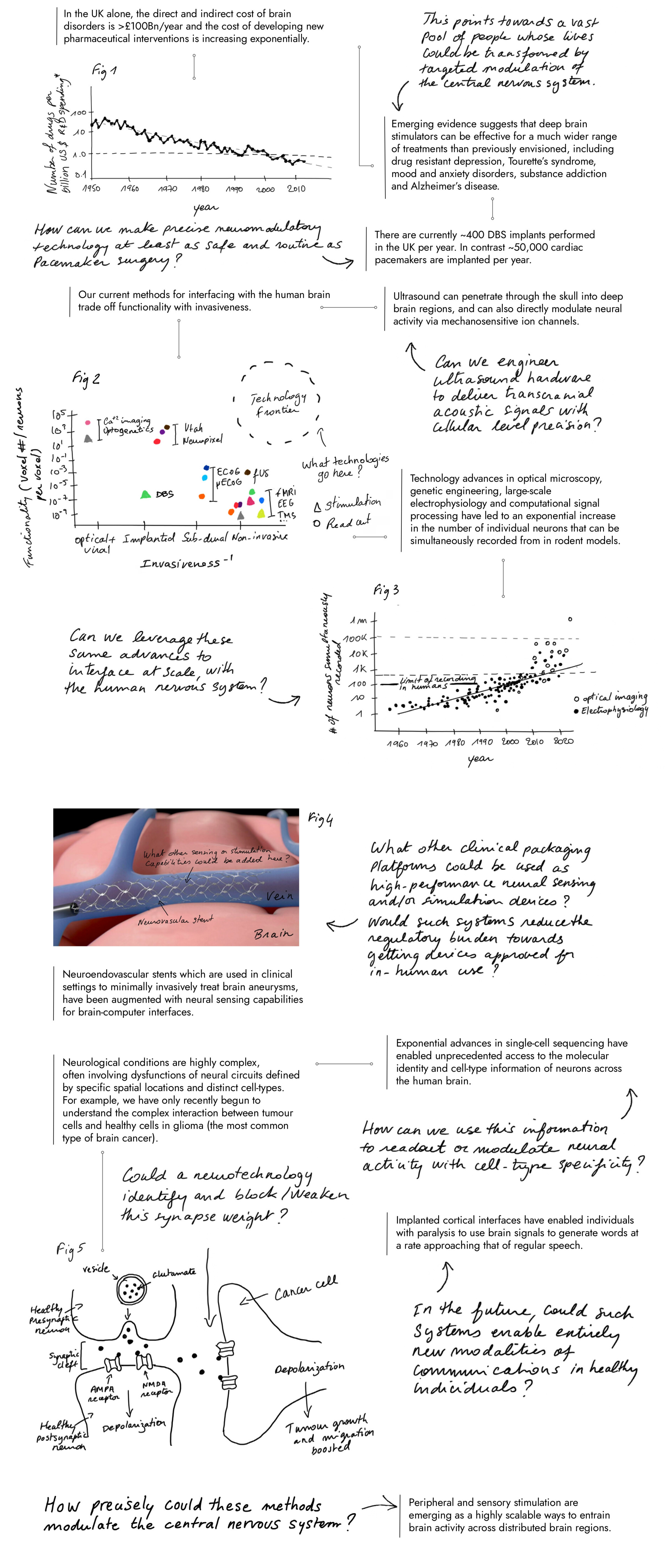
Neurological and neuropsychiatric disorders have overwhelming societal and economic impacts. We need a new suite of tools that enable us to interface, at scale, with the human brain.
What if we could solve the mysteries of neurological disorders and mental health by interfacing with the brain in new ways?
Defined by our Programme Directors (PDs), opportunity spaces are areas we believe are likely to yield breakthroughs.
In Scalable Neural Interfaces, we are exploring how to advance highly targeted minimally-invasive neurotechnologies to understand and repair the brain.
Beliefs
The core beliefs that underpin this opportunity space:
Targeted interaction with the human brain can improve the human condition across an incredibly wide range of disease states and cognitive domains → we need to dramatically and safely increase the throughput (no. procedures per day/£) at which these technologies can be deployed to understand their full potential and deliver them at scale.
Current paradigms for interfacing with the human brain trade off precision for invasiveness of the procedure → there’s no fundamental reason we can’t build technologies that are both highly targeted and minimally invasive.
To fully understand and treat disorders of the brain, we’ll need neural technologies that simultaneously offer chemical, temporal, and spatial specificity → this is achievable only by connecting the frontiers of engineered hardware with the frontiers of engineered biology.

The mission to get breakthrough brain treatments to everyone
Programme Director Jacques Carolan sat down with Juan Benet to discuss his journey, what it means to lead ambitious R&D, and the future we could unlock if next-generation brain therapies can genuinely scale.
Programmes
To build a programme within an opportunity space, our Programme Directors direct the review, selection, and funding of a portfolio of projects.
While the first programme in this opportunity space, Precision Neurotechnologies, is focused on the precise modulation of neural circuits, we're expanding this opportunity space and have launched a second programme, Massively Scalable Neurotechnologies, centred on the challenges of scaling and addressing bottlenecks around accessibility. Learn more about these below.
Precision Neurotechnologies
Many neurological and neuropsychiatric disorders are neural circuit-level disorders, or problems with the ‘wiring’ of the brain. Current technologies lack the precision to treat this and most are highly invasive. Backed by £69m, this programme seeks to develop next-generation neurotechnologies that operate at the circuit level, across distributed brain regions and with cell type specificity.
Massively Scalable Neurotechnologies
Neurological and neuropsychiatric disorders are the leading cause of global disability, yet today’s most advanced treatments rely on complex surgical procedures. This limits access to only the most severe cases and prevents early intervention for millions. Backed by £50m, this programme is seeking radically new ways to deliver responsive neurotechnologies to the brain without brain surgery.